The Journey of Halal Certification Bodies: Achievements and Challenges
DOI:
https://doi.org/10.55265/halalreviews.v5i1.151Keywords:
Halal Certification, Non-Muslim Countries, Argentina Halal Industry, Halal Governsnce, Global Halal TradeAbstract
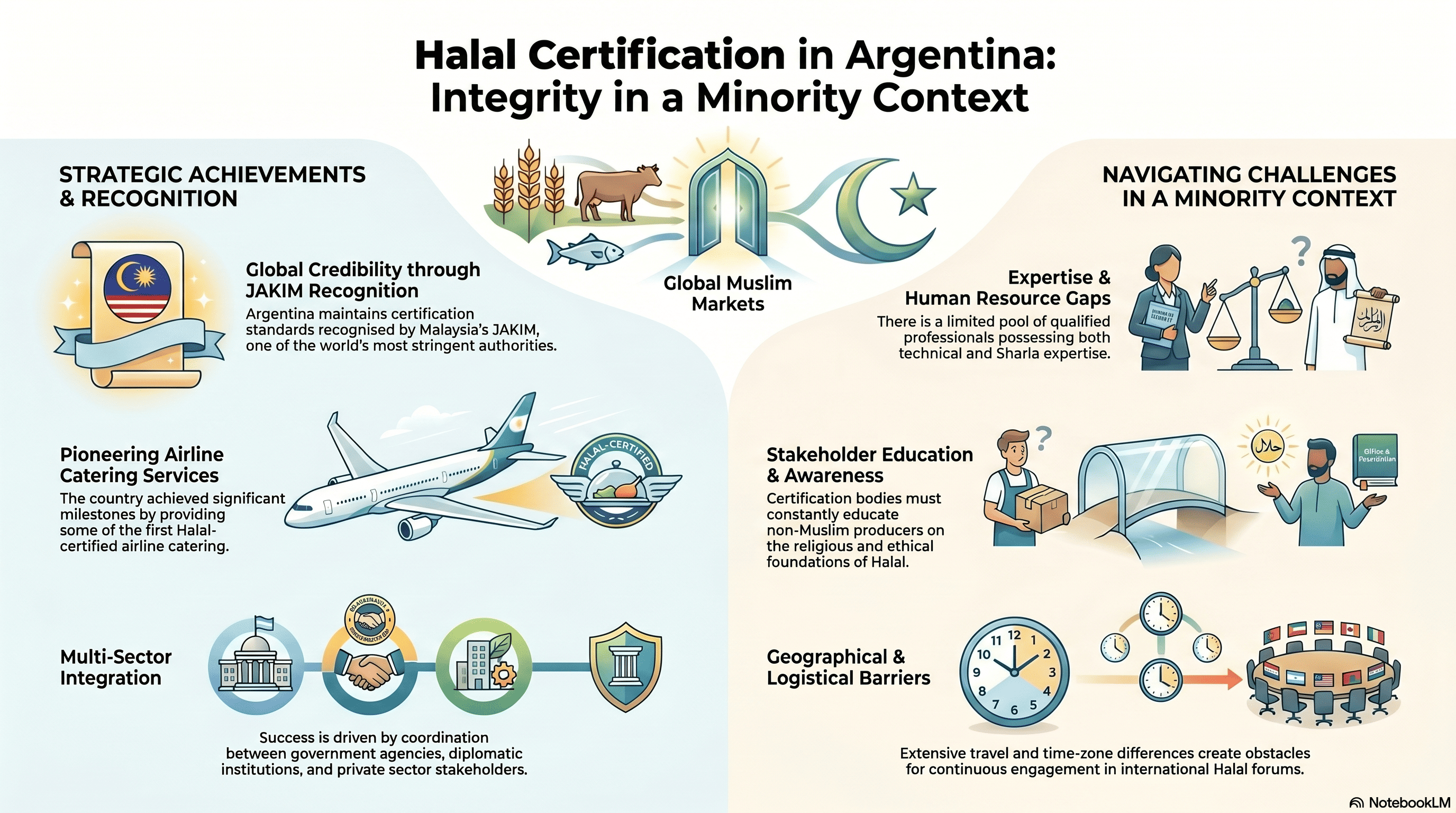
This study examines the development of Halal certification in Argentina as a case of sustaining Halal integrity within a non-Muslim-majority context. It highlights the roles of historical migration, knowledge exchange, institutional collaboration, and consumer awareness in shaping the Halal ecosystem. The study identifies key challenges, including limited expertise, logistical constraints, and the need to engage non-Muslim stakeholders, while also recognizing achievements such as international recognition and market expansion. The findings emphasize that education, global collaboration, and adherence to Islamic principles are essential for maintaining credibility and ensuring the sustainable growth of the Halal industry.
References
Abdallah, A. E., Rahem, M. A., & Pasqualone, A. (2021). The multiplicity of halal standards: A case study of application to slaughterhouses. Journal of Ethnic Foods, 8(1). https://doi.org/10.1186/s42779-021-00084-6
Adham, K. A., Muhamad, N. S., Said, M. F., & Nasir, N. M. (2024). Halal and Muslim-minority countries: A systematic literature review. Institutions and Economies, 16(4), 41–77. https://doi.org/10.22452/ijie.vol16no4.2
Ahmad, Z., Mafaz, M. N. A., & Rahman, D. M. M. (2023). Harmony in halal: Understanding stakeholder views analyzing products and evaluating policies in Malaysia. West Science Business and Management, 1(5), 495–508. https://doi.org/10.58812/wsbm.v1i05.358
Al-Mahmood, O. A., & Fraser, A. (2023). Perceived challenges in implementing halal standards by halal certifying bodies in the United States. PLOS ONE, 18(8). https://doi.org/10.1371/journal.pone.0290774
Alzeer, J., Hadeed, K. A., & Tufail, F. (2025). The halal positive list: Streamlining the path to certification. Halalsphere, 5(1), 1–7. https://doi.org/10.31436/hs.v5i1.109
Azam, M. S. E., & Abdullah, M. A. (2020). Global halal industry: Realities and opportunities. International Journal of Islamic Business Ethics, 5(1), 47–59. https://doi.org/10.30659/ijibe.5.1.47-59
Balah, K. O., & Makakena, S. D. (2024). Perspectives and implications of halal food consumption among major Islamized groups in the Philippines: Strengthening consumer confidence, standardization, and traceability. Halal Research Journal, 4(1), 12–27. https://doi.org/10.12962/j22759970.v4i1.750
Bouzraa, T., Escudero, U., Ruiz, B., & Serrano, J. G. (2023). Influence of halal institute certification activity on Spanish market exports. Ekonomski Izazovi, 12(24), 31–39. https://doi.org/10.5937/ekoizazov2324031t
Busari, S. A., & Sitiris, M. (2021). Standardisation of halal industry towards sustainable development goals (SDG) [Penyeragaman industri halal ke arah matlamat pembangunan yang mampan (SDG)]. Journal of Islam in Asia, 18(1), 163–198. https://doi.org/10.31436/jia.v18i1.1001
Dahlan, A., Shafiai, M. H. M., Wildan, M., Voak, A., & Sugimoto, K. (2025). A laissez-faire approach of Muslim NGOs as minorities in shaping the halal industry and Islamic banking law in Japan. AHKAM Jurnal Ilmu Syariah, 25(2), 321–338. https://doi.org/10.15408/ajis.v25i2.46880
Demirci, M. N., Soon, J. M., & Wallace, C. A. (2016). Positioning food safety in halal assurance. Food Control, 70, 257–270. https://doi.org/10.1016/j.foodcont.2016.05.059
Dewi, R. D. C., & Suryono, S. (2025). Improving medical wellness with halal and thayyib certification in traditional health services: A literature review. Jurnal PROMKES, 13(2), 257–262. https://doi.org/10.20473/jpk.v13.i2.2025.257-262
Elasrag, H. (2016). Halal industry: Key challenges and opportunities. SSRN Electronic Journal. https://doi.org/10.2139/ssrn.2735417
Fadhillah, A. A., & Saputra, R. P. (2025). Systematic review: Comparison of halal regulations in Asia. Journal of Halal Science and Research, 6(2), 134–146. https://doi.org/10.12928/jhsr.v6i2.12111
Halawa, A. (2022). The role of immigration and colonization in the acculturation of halal food in European countries: An evidence-based systematic review. International Journal of Social Science Research and Review, 5(9), 31–46. https://doi.org/10.47814/ijssrr.v5i9.425
Hamid, M. A., Yeap, C. H., Martony, O., & Devi, M. (2022). Halal in the food industry around the globe. Journal of Halal Science and Technology, 1(2), 12–21. https://doi.org/10.59202/jhst.v1i2.609
Hidayat, Y., & Machmud, A. (2024). The existence and consistency of halal certificates in the global ecosystem of halal products and services. Amwaluna: Jurnal Ekonomi Dan Keuangan Syariah, 8(1), 102–112. https://doi.org/10.29313/amwaluna.v8i1.2975
Idris, P. S. R. P. H. (2024). Navigating halal certification challenges in Japanese restaurants: Insights and strategies for success. Journal of Halal Science Industry and Business, 2(1), 1–14. https://doi.org/10.31098/jhasib.v2i1.2299
Ismail, I., Soemitra, A., Nawawi, Z. M., & Tarigan, A. A. (2025). Towards a sustainable halal ecosystem: Regulators’ perspectives in the era of mandatory halal certification 2026. Pena Justisia Media Komunikasi Dan Kajian Hukum, 24(1), 336–354. https://doi.org/10.31941/pj.v24i1.5970
Jannah, S. M., & Al-Banna, H. (2021). Halal awareness and halal traceability: Muslim consumers’ and entrepreneurs’ perspectives. Journal of Islamic Monetary Economics and Finance, 7(2), 285–316. https://doi.org/10.21098/jimf.v7i2.1328
Kassim, E. S., Osman, I., Omar, E. N., & Hassan, F. (2023). Exploring the role of student exchange programs in fostering halal understanding among South Korean non-Muslims. Information Management and Business Review, 15, 159–172. https://doi.org/10.22610/imbr.v15i3(i).3526
Kurahman, O. T., Priatna, T., & Cahyanto, T. (2023). Reorientation of halal literacy education development in the curriculum of Islamic educational institutions: An alternative concept. Edukasi Islami: Jurnal Pendidikan Islam, 12(1). https://doi.org/10.30868/ei.v12i01.3190
Muhammad, N., Noor, M. A. M., Marasabessy, S. A., & Mel, M. (2025). Sustainable development platform for a halal ecosystem: An alternative solution. Industrial Engineering & Management Systems, 24(4), 611–623. https://doi.org/10.7232/iems.2025.24.4.611
Munir, S., & Hannase, M. (2025). Navigating global halal standardization: A pluriversal (multi-worldview) approach to fiqh diversity and minority inclusion. In Atlantis Highlights in Social Sciences, Education and Humanities (pp. 95–112). Atlantis Press. https://doi.org/10.2991/978-94-6463-918-6_7
Nizar, M., & Ahmad, M. Z. (2025). Halal governance and its societal impact: A comparative study of certification regimes in Indonesia and Malaysia for Muslim families. BIOTIK: Scientific Journal of Biology Technology and Education. https://doi.org/10.22373/ujhk.v8i2.29191
Nursita, R. D. (2025). Intermestic determinants influencing Indonesia’s vision to become the global halal hub. Dauliyah Journal of Islamic and International Affairs, 10(2), 84–100. https://doi.org/10.21111/dauliyah.v10i2.13244
Ohgata, S. (2024). What is required of halal standards and halal certification systems in the global era? Islam Nusantara: Journal for Study of Islamic History and Culture, 5(2), 1–35. https://doi.org/10.47776/islamnusantara.v5i2.1186
Othman, Y., Awang, M. N., & Shah, H. A. R. (2023). Legal and regulatory challenges of halal certification: Insights from cosmetic manufacturers on halal built-in implementation. International Journal of Academic Research in Business and Social Sciences, 13(1). https://doi.org/10.6007/IJARBSS/v13-i1/15785
Pradhan, A., Rane, J., & Reddy, K. S. (2025). Inclusion of quinoa in cropping systems for ensuring food and nutrition security in drought prone semi-arid regions: An energy-water-carbon-food nexus approach. Energy, 330, 136892. https://doi.org/10.1016/j.energy.2025.136892
Prawiro, A., & Fathudin, F. (2023). Challenges in the halal industry ecosystem: Analyzing the halal certification process for micro, small, and medium enterprises in Lombok, West Nusa Tenggara. Mazahib, 22(2), 431–484. https://doi.org/10.21093/mj.v22i2.7010
Rahman, M. M., & Ahmad, Z. (2024). Ensuring halal product integrity and an investigative study of U.S policy practices. Journal of World Science, 3(1), 58–68. https://doi.org/10.58344/jws.v3i1.528
Salam, S. A., Mohd, H., Muflih, B. K., & Jaiyeoba, H. B. (2023). Halal industry and standardization. Ekonomski Izazovi, 12(24), 20–30. https://doi.org/10.5937/ekoizazov2324020s
Saleh, H., & Rajandran, T. (2024). Non-Muslim acceptance of halal product in Malaysia. International Journal of Academic Research in Business and Social Sciences, 14(12). https://doi.org/10.6007/IJARBSS/v14-i12/24093
Serrano, S., Bouzraa, S., Escudero, M., Ruiz, B. Z. D., & Rodríguez, I. (2025). Influence of halal certification on exports markets: Case study: Halal institute certification impact on Spanish meat market exports. Journal of Halal Science Industry and Business, 3(2), 15–29. https://doi.org/10.31098/jhasib.v3i2.3357
Soon, J. M., Chandia, M., & Regenstein, J. M. (2016). Halal integrity in the food supply chain. British Food Journal, 119(1), 39–51. https://doi.org/10.1108/BFJ-04-2016-0150
Sorna, U. S., Firdaus, R. B. R., & Sarjiyanto, S. (2024). Challenges and ways forward for the Malaysian SMEs in the halal food industry: A systematic review. Potravinarstvo Slovak Journal of Food Sciences, 18, 223–238. https://doi.org/10.5219/1937
Tayob, S. (2021). Sustainability and halal: Procedure, profit and ethical practice. Journal of Digital Marketing and Halal Industry, 3(2), 95–110. https://doi.org/10.21580/jdmhi.2021.3.2.9586
Tumiwa, R. A. F., Ningsih, G. M., Romarina, A., Setyadjit, S., Slamet, B., Waruwu, E., Ie, M., & Utomo, Y. T. (2023). Investigating halal food supply chain management, halal certification and traceability on SMEs performance. Uncertain Supply Chain Management, 11(4), 1889–1896. https://doi.org/10.5267/j.uscm.2023.6.003
Uršulin-Trstenjak, N., Dugonjić, A., & Kanižaj-Rogina, Ž. (2023). Awareness of halal products among the general population. Ekonomski Izazovi, 12(24), 1–11. https://doi.org/10.5937/ekoizazov2324001t
Urus, N. S. T., Azzis, N. M. A., Roslan, E. S., & Affendi, S. N. Y. S. N. (2025). Global recognition of halal certification: A fundamental, innovative, and international paradigm for ensuring integrity and enhancing competitiveness in the global halal industry. International Journal of Academic Research in Business and Social Sciences, 15(9). https://doi.org/10.6007/IJARBSS/v15-i9/26470
Urus, N. S. T., Khotib, N. A. B. M., Aziz, M. A., & Salim, S. S. (2025). The role of UniSHAMS Halal Management Center in strengthening the global halal ecosystem: Strategies, challenges, and innovations. International Journal of Academic Research in Business and Social Sciences, 15(6). https://doi.org/10.6007/IJARBSS/v15-i6/25747
Voak, A., Fairman, B., & Wahyuni, H. C. (2023). Halal supply chain competencies. Journal of Resilient Economies, 3(2). https://doi.org/10.25120/jre.3.2.2023.4021
Yuanitasari, D., Harrieti, N., & Salaeh, Y. (2025). Harmonizing Sharia-based halal standards with international trade law: A comparative legal study. Lampung Journal of International Law, 7(1), 47–62. https://doi.org/10.25041/lajil.v7i1.4468
Ребезов, М., Khayrullin, M., Assenova, B., Farida, S., Baydan, D. V., Garipova, L., Savkina, R. V., & Родионова, С. С. (2024). Improving meat quality and safety: Innovative strategies. Potravinarstvo Slovak Journal of Food Sciences, 18, 523–546. https://doi.org/10.5219/1972
Downloads
Published
How to Cite
Issue
Section
License
Copyright (c) 2025 Melody Amal Khalil Kabalan

This work is licensed under a Creative Commons Attribution-NonCommercial-ShareAlike 4.0 International License.