From Knowledge to Impact: Human Capital as The Key to Halal Growth
DOI:
https://doi.org/10.55265/halalreviews.v5i1.152Keywords:
Halal Education, Workforce Readiness, Curriculum Development, Interdisciplinary Learning, Halal IndustryAbstract
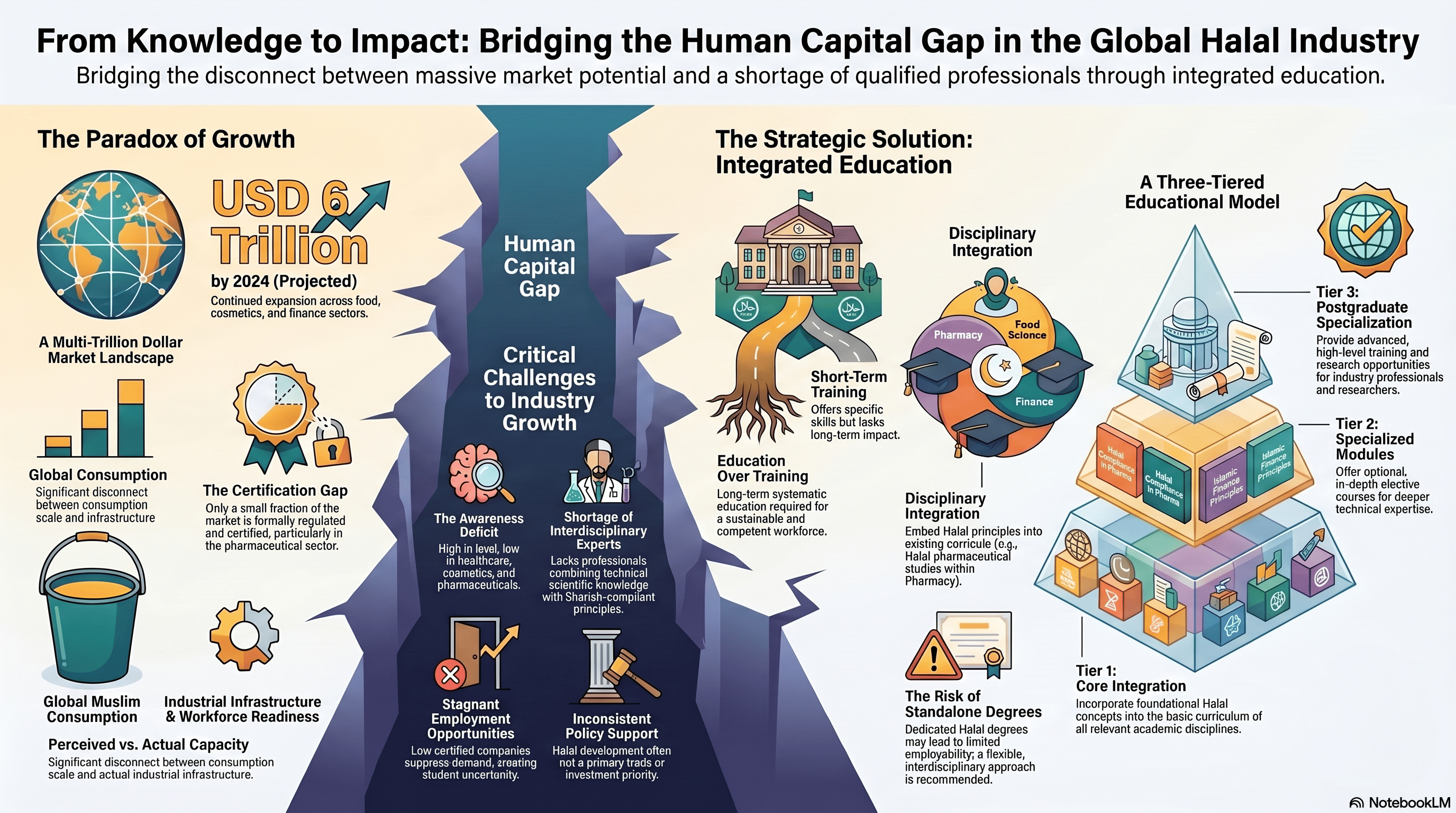
This paper examines the rapid expansion of the global Halal industry, projected to reach nearly USD 6 trillion by 2024 and grow to around USD 4.6 trillion by 2030 across sectors including food, pharmaceuticals, cosmetics, finance, and tourism, juxtaposed against persistent workforce deficiencies such as limited awareness of Halal principles, shortages of interdisciplinary experts, scarce employment opportunities, and inadequate policy support. Despite substantial market potential, the certified Halal segment remains underdeveloped, underscoring a critical gap between perceived growth and human capital readiness. It argues for reframing Halal education in higher institutions through integration into existing disciplines like pharmacy, food science, and finance—rather than standalone degrees—to enhance employability and sustainability, drawing on successful models from Malaysia, Brunei, and Indonesia. A tiered, flexible educational framework is proposed to foster competent professionals, emphasizing stakeholder collaboration, standardization, and long-term curriculum reforms to align education with industry demands.References
Alserhan, B. A., Bayırlı, M., & Zakzouk, F. (2020). Awareness towards halal pharmaceuticals: An analysis of pharmacists’ views. International Journal of Islamic Marketing and Branding, 5(1), 43–57. https://doi.org/10.1504/ijimb.2020.109065
Azam, M. S. E., & Abdullah, M. A. (2020). Global halal industry: Realities and opportunities. International Journal of Islamic Business Ethics, 5(1), 47–59. https://doi.org/10.30659/ijibe.5.1.47-59
Hidayat, Y., & Machmud, A. (2024). The existence and consistency of halal certificates in the global ecosystem of halal products and services. Amwaluna: Jurnal Ekonomi dan Keuangan Syariah, 8(1), 102–112.https://doi.org/10.29313/amwaluna.v8i1.2975
Ibrahim, M. I., Jamaludin, M. A., Zubairi, A. M., Muflih, B. K., & Hashim, Y. Z. H.-Y. (2022). Development of framework for halal studies program evaluation. Halalsphere, 2(1), 98–105. https://doi.org/10.31436/hs.v2i1.28
Islam, M. M., Talib, M. S. A., & Muhamad, N. (2023). Challenges of halal standards and halal certification for Islamic marketing. Muslim Business and Economic Review, 2(1), 105–124. https://doi.org/10.56529/mber.v2i1.156
Jaber, D., Hasan, H. E., Alkaderi, A., Alkilani, A. Z., & El-Sharif, A.-R. (2024). Assessment of the knowledge, attitude, and perception of healthcare providers regarding halal pharmaceuticals. The Open Public Health Journal, 17(1), Article e18749445296459. https://doi.org/10.2174/0118749445296459240322064212
Rachman, M. A. (2019). Halal industry in Indonesia: Role of sharia financial institutions in driving industrial and halal ecosystem. Al-Iqtishad: Jurnal Ilmu Ekonomi Syariah, 11(1), 35–58. https://doi.org/10.15408/aiq.v11i1.10221
Rizki, D., Hamzah, M., Fakhiroh, Z., & Hendri, D. (2023). Best practice halal integrity management in the logistic chain scheme: Analysis of opportunities and challenges. Journal of Islamic Economic Laws, 6(1), 13–29. https://doi.org/10.23917/jisel.v6i1.19867
Sulaiman, N. S., Abdullah, R., & Hashim, N. (2023). Halal industry development in Brunei Darussalam: Realities and challenges. KnE Social Sciences, 1013–1029. https://doi.org/10.18502/kss.v8i18.14308
Downloads
Published
How to Cite
Issue
Section
License
Copyright (c) 2025 Mohammed Ali Alsheikh Wace

This work is licensed under a Creative Commons Attribution-NonCommercial-ShareAlike 4.0 International License.